

Subscribe
Logo
Logo
  • Topics Icon Topics
    • AI Icon AI
    • Banking Icon Banking
    • Blockchain/DeFi Icon Blockchain/DeFi
    • Embedded Finance Icon Embedded Finance
    • Fraud/Identity Icon Fraud/Identity
    • Investing Icon Investing
    • Lending Icon Lending
    • Payments Icon Payments
    • Regulation Icon Regulation
    • Startups Icon Startups
  • Podcasts Icon Podcasts
  • Products Icon Products
    • Webinars Icon Webinars
    • White Papers Icon White Papers
  • TechWire Icon TechWire
  • Search
  • Subscribe
Reading
Diversification and P2P Lending – Part 1
ShareTweet
Home
Peer to Peer Lending
Diversification and P2P Lending – Part 1

Diversification and P2P Lending – Part 1

Fintech Nexus Staff·
Peer to Peer Lending
·May. 22, 2015·2 min read

Being diversified across many loans is one of the keys to having a successful experience when investing in p2p lending. As with other investments, diversification will reduce the chances of your investment returns experiencing volatility.

Both Prosper and Lending Club provide statistics on owning at least 100 loans. This equates to a total investment of $2,500 investment across 100 loans ($25 per loan) and should be the bare minimum to start with when opening a Lending Club or Prosper account. Certainly adding more notes would be a wise decision as we will explore in this post and our second, more in depth post on this topic.

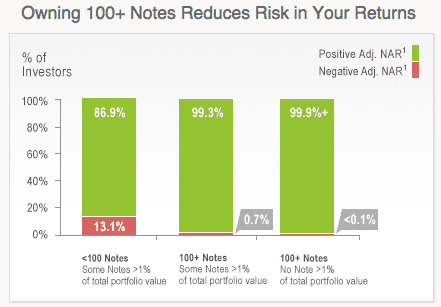
Below is Lending Club’s guide on diversification. Note that that the percent of investors who earn a negative adjusted net annualized return decreases significantly when you own at least 100 notes and no one loan accounts for greater than 1% of your total portfolio.  It is important that if you are purchasing just 100 loans, that the investment in each loan is the minimum amount allowed of $25.
Lending Club Loans Diversification

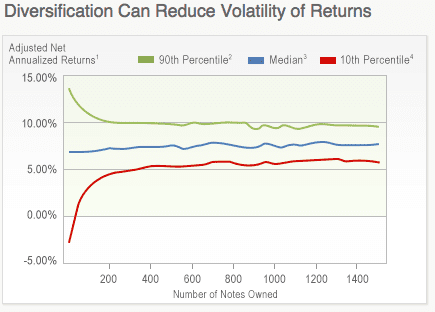
The below graph from Lending Club shows the extreme volatility with portfolios under 100 loans. At the 100 loan mark, even though returns may still be more likely to be positive, there is a wide range possible. Around the 200 loan mark, volatility begins to taper off substantially and offers the much more consistent returns that seasoned investors are used to.
Lending Club Volatility

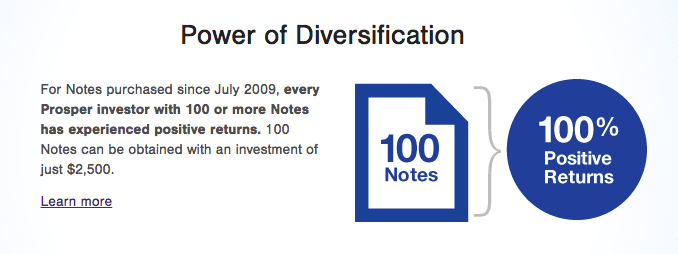
Prosper, similar to Lending Club advertises that 100 loans is the minimum amount of loans you should own when investing. However, they claim that 100% of investors that own 100 or more notes are achieving positive returns.
Prosper Diversification

Can I be too diversified?

In general, having more loans will not affect your performance. Just take a look at the chart from Lending Club above. You don’t see much benefit from diversifying beyond around 500 loans, but even at 1,500 loans you are not hurting your performance.

The exception is if you have strict criteria for loans that you believe may out-perform the averages. In this case, if you are loosening your criteria in order to be fully invested, there is a chance that your returns may be affected. Given the robust volume of notes that Lending Club is originating, it is unlikely that any but the extremely large investors would run into this issue.

Learn More on Diversification

The main issue with this analysis from Lending Club is the fact that it is based on historical information, which does not include a probable increase in defaults during a recession. It is possible that during a recession that a 100 note portfolio will perform far worse than accounts that own several hundred or even thousands of notes. In part 2 of our discussion on diversification, the Chief Credit Officer of NSR Invest will shed some light on how many notes you should own for full diversification given different assumptions and economic environments.

  • Fintech Nexus Staff
    Fintech Nexus Staff

    This piece was created by one of our content team members. Reach us at [email protected]

    View all posts
Tags
diversificationLending ClubProsper
Related

LendingClub exceeds expectations in strong Q1 earnings

LendingClub delivers better than expected earnings in Q4 2023

New SBA Lending Rules Are Only a Start

LatAm fintechs

How LatAm fintechs are diversifying their businesses to tackle challenging times

Popular Posts

Today:

  • FUTURE NEXUS IMAGE TEMPLATES!! (2)OCC Hints at Trouble for Charters Jun. 18, 2026
  • Fonoa (2)Funded: Fonoa raises $110M to build the operating system for autonomous tax May. 29, 2026
  • Ethan ChanAllium CEO Ethan Chan on making blockchain data usable Sep. 3, 2026
  • Nic BairdThe $10,000 inference trap: A former pro sailor’s fix for AI’s money problem Oct. 1, 2026

This month:

  • FUTURE NEXUS IMAGE TEMPLATES!! (2)OCC Hints at Trouble for Charters Jun. 18, 2026
  • Dr. Devi Parikh“Too heavy of a hammer”: How Yutori is beating AI giants at building the web’s future Sep. 10, 2026
  • Ram PalaniappanIn 2026, Your Wages Should Not Be On a Two-Week Delay Aug. 20, 2026
  • Ryan WigginsMercury’s Ryan Wiggins on Building Customer Trust: Lessons from a Decade at Facebook and WhatsApp Jul. 2, 2026
  • Santiago SuarezInside Addi’s mission to build a fairer financial system in Colombia Feb. 19, 2026
  • Dr. Jean NehmeHardware as a durable moat & the former surgeon’s bet on “soft robotic cells” Aug. 27, 2026
  • Ethan ChanAllium CEO Ethan Chan on making blockchain data usable Sep. 3, 2026
  • TitoEscaping the demo: The founders building the foundation for medtech physical AI Jul. 23, 2026
  • FNMerge CEO on building the pipes behind AI, and starting with zero code May. 21, 2026
  • 197Renton’s Take on Loan Model Risks Nov. 4, 2025

More News
  • About
  • Contact
  • Disclaimer
  • Privacy Policy
  • Terms
Subscribe
Copyright © 2026 Fintech Nexus
  • Topics
    • AI
    • Banking
    • Blockchain/DeFi
    • Embedded Finance
    • Fraud/Identity
    • Investing
    • Lending
    • Payments
    • Regulation
    • Startups
  • Podcasts
  • Products
    • Webinars
    • White Papers
  • TechWire
  • Contact Us
Start typing to see results or hit ESC to close
lis digital banking USA Lending Club UK
See all results