

When Adyen talked with more than 200 companies about the coming wave of AI shopping agents, one fear came up in every single conversation: disintermediation. Brands that spend millions building a relationship with a customer do not want an AI agent stepping between them and that customer, turning them into an interchangeable supplier.
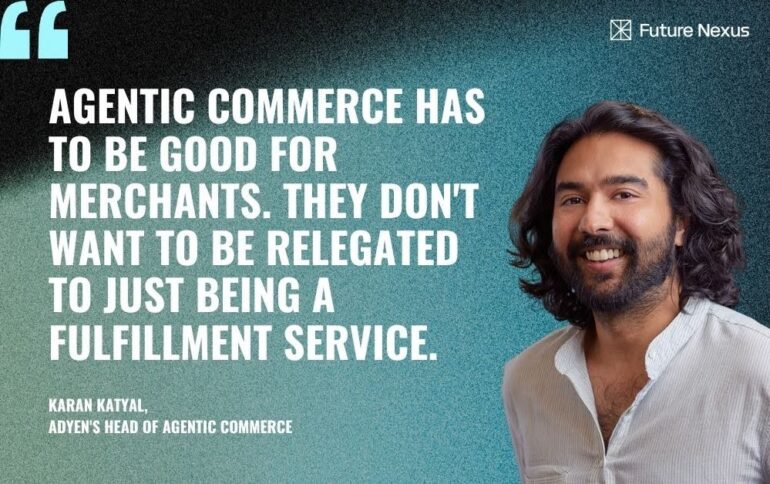
“They don’t want to be relegated to just being a fulfillment service,” said Karan Katyal, Adyen’s head of agentic commerce. “It has to be good for merchants or they’re not going to play ball.”
That fear is the design brief for Adyen Agentic, the agentic-commerce infrastructure from the global fintech, which processed more than €1.39 trillion in payment volume in 2025 and whose customers include Meta, Uber, H&M, eBay and Microsoft. With agentic commerce developing at light speed, retail brands have a litany of legitimate questions about its use. They also know they have to get on the train or be left behind.
What Adyen Agentic is
Adyen Agentic is an open-ecosystem layer that helps merchants sell across conversational AI platforms through a single integration. That means a shopper could ask an AI assistant to find running shoes and complete the purchase inside the conversation, with the brand’s own catalog, pricing and checkout running underneath.
Adyen Agentic includes three layers. Agentic Feed is a structured product and inventory layer distributing real-time catalog, pricing, and availability data across conversational commerce environments. Agentic Cart, an orchestration layer, connects existing merchant systems to conversational platforms, while Agentic Payments facilitates agent-led transactions via authentication, token portability, merchant-of-record preservation, and risk management across evolving protocols.
The premise was sufficient to attract American Express, Visa, Salesforce, Scheels, and several other notable brands as partners.
The four types of agentic commerce
Katyal said Adyen Agentic’s design supports four distinct types of agentic commerce, beginning with consumer commerce with a human in the loop: agents generate options, and the human ultimately chooses.
The second is autonomous consumer commerce. Think booking a flight or your regular grocery order; the system knows your preferences and acts on your behalf. Katyal said this takes massive levels of consumer trust that must be earned over time (more on that later).
The third, machine-to-machine agentic commerce, is software paying software through connections with web hosts and software providers.
The fourth and most nascent category is B2B procurement and payments.
Ecosystem-first pillars
Agentic commerce product lead Jon Sheinfeld said Adyen’s vision was a universal translator that easily connects merchants and shoppers. That idea rests on three main pillars.
First, it must be merchant-centric, with the brand maintaining its image and message.
“Our view is to deepen relations between the merchant and shopper,” Sheinfeld said.
Second, the ecosystem must remain open. Merchants must be able to participate without ripping and replacing their existing technologies to connect with each new agentic protocol.
And third, merchants have to trust the system’s ability to protect data and to easily facilitate payments.
Sheinfeld and Katyal admitted that adherence to that open-ecosystem philosophy brought challenges. Each merchant’s system is unique, with some using in-house systems and others relying on third parties. Adyen created a matrix of possible outcomes and worked to forge connections. The extra work, they said, was crucial to maintaining Adyen’s vision.
“For us, being open is the clearest way to develop something that companies want to engage with,” Katyal explained.
The disintermediation fear
Adyen heard companies’ concerns about remaining discoverable online and maintaining control over the customer experience, and designed to answer this disintermediation fear directly. Product catalogs are machine-readable, syndicated, and pushed out so they’re easily discoverable. Agentic commerce experiences are set up on the merchant’s own website, instead of on a third party’s. The merchant is always the merchant of record, so their relationship with the shopper is uninterrupted.

“Third-party experiences are when you see tension with platforms who own the shopper and brand user experience,” Sheinfeld said.
Could agentic commerce create new forms of competition and differentiation? It could, but that would force merchants to make decisions Adyen doesn’t want them to have to make. Working at the infrastructure level, Adyen takes a protocol-agnostic approach: as new standards and systems emerge, Adyen Agentic accommodates them. The experience is consistent across channels, and merchants aren’t forced to pick a winner.
“Those little decisions we made paid big dividends,” Katyal said.
Three open questions
Agentic commerce also raises several fundamental e-commerce questions. The first: traditionally, the click signals intent. What is the agentic commerce equivalent, if anything?
Katyal returned to the four agentic commerce types. The first keeps humans in the loop. With the other three, Sheinfeld said it comes down to the intent the consumer is trying to get across. Admittedly less tangible, it can potentially be determined through customer queries or agentic interactions earlier in the process.
The second question: could pay-to-play dynamics influence agentic commerce recommendations?
Katyal said it would be silly to try in such early days, akin to the mid-1990s internet. With only the thinnest sliver of consumers now participating in agentic commerce, there’s not much to manipulate.
The focus must be on building trust. If a system generates recommendations significantly different from consumers’ preferences, they’ll abandon the system entirely. Sheinfeld added that current regulations impose disclosure obligations on search engines that boost recommendations. Adyen’s priority is ensuring merchants can get the information they need to the right place so consumers can ingest it.
And the third: how does agentic commerce change the nature of fraud?
After decades of being told that bots are bad, consumers, merchants, and fraud-protection system designers must now adapt to bots having positive uses.
From a design perspective, Sheinfeld said the focus largely remains the same: determining data legitimacy. The more good data and context you have, the better your ability to make accurate decisions.
“The crux is how can we share the right information with the right stakeholders in a way that’s privacy conscious,” Sheinfeld said.
Timeline for agentic commerce
Agentic commerce isn’t even in the early innings. It’s so new that the players aren’t even at the ballpark yet. Katyal said the volume in 2026 is effectively zero and 2027’s will only inch forward. But he expects a substantial portion of e-commerce to be agentic by 2030.
That buys providers time that they should use wisely. Start with a desired future and work backwards. Be positioned as a partner no matter which future materializes.
So who is adopting now? Early movers share a profile: a heavy U.S. presence, established brand identities, and large revenue bases upwards of $500M in gross merchandise volume (GMV). They’re tech-savvy and not reliant on outside providers.
“They also have some sort of leadership push, but not one that requires instant volume or near-term ROI,” Katyal said.
The window before 2030, in other words, is not dead time. It’s the period in which merchants decide whether they’ll be able to own their shelf in the agentic aisle or stock someone else’s.