
QED’s Victoria Zuo on underwriting agentic payments, building financial services for AI, and why she still hasn’t connected her own bank account to ChatGPT.
QED Investors partner Victoria Zuo is, without doubt, an artificial intelligence enthusiast.
But for now at least, the San Francisco-based fintech and e-commerce investor has reservations about sharing personal financial information with generic horizontal AI agents.
“It comes down to trust. I still haven’t linked my bank accounts to my ChatGPT Pro account,” Zuo told Future Nexus.
She’s hopeful that in the near future she’ll be able to rely on — as well as invest in — a vertical AI agent that specializes in either financial services, capable of handling personal finance, investing and insurance needs, or healthcare, with the ability to navigate care, complete insurance payments and negotiate denied claims.
“Creating ultimate trust and security is very necessary,” added Zuo, who is energized by the innovation occurring in the category.
While contemplating the impact of AI within fintech, Zuo has been pondering the assignment of a risk premium to agentic payments as well as the related concept of underwriting human-present and human-not-present transactions.
“Vendors should be properly rewarded for that risk, similar to how interchange fees are different between card-present and card-not-present transactions,” she mused, identifying authentication and authorization as key to mitigating potential chargebacks and fraudulent requests.
As an example, startups focused on granular access or permission controls for payments could be interesting to QED, she said.
Separately, Zuo recognizes that the industry has evolved to a new mode of direct interactions between businesses and agents, moving beyond answer engine optimization, or the process of ensuring products and services are easily discovered by AI agents.
It’s an insight she’s gained courtesy of one of her portfolio companies: Lorikeet, a Sydney-based AI customer concierge startup which recently launched a product enabling merchants to answer agents’ questions.
“Now that transactions are happening with consumers closing the purchasing loop, you want to serve up the information packet including product descriptions, return policies and refund policies to the agent rather than humans,” Zuo said.
“Agents obviously consume content and make decisions slightly differently to humans, so we are seeing startups pop up in this category that allow businesses to serve up conversion modules to agents. It’s super exciting, and I think a lot of the ecosystem will be built around us.”
Unrelatedly, Zuo believes financial services could prove to be a business model rather than a product, and a significant driver of revenue growth for personal agents such as Instinct and Muse.
“Everyone’s talking about how hard it will be to cover inference spend with subscriptions because consumers don’t want to pay a lot. Even OpenAI has had a challenging time charging for premium subscriptions… But a lot of monetization for AI businesses could come from financial services like payments, credit and lending, BNPL affiliate fees and advertising.”
That’s akin to the business models of car marketplaces like Carvana and Kavak, both backed by QED, which derive revenue from financial services such as loan originations and commissions earned from selling insurance.
“I think this is going to increasingly be the case for a lot of consumer-oriented AI businesses in the next few years.”
Zuo is also deeply interested in neoclouds and GPU financing.
“We’ve been quite active in writing new checks [backing] GPU financing and funding next-gen neoclouds in different regions and different chip types,” she said, declining to provide specifics as those transactions are yet to be announced.
“We think at the end of day, a lot of these businesses will end up looking like equipment leasing businesses, which we know very well.”
But for certain point solutions, or specialized software tools, QED is taking an increasingly cautious approach.
“A lot of these businesses can grow really fast because they find a very narrow wedge, but if they’re never able to expand outside of that, they end up getting trapped pretty quickly, and there’s very limited value that you can build.”
Zuo, a Stanford graduate, began her career at Qatalyst Partners and Google’s Gradient Ventures before meeting the QED team and managing partner Nigel Morris, perhaps best known for co-founding Capital One.
“I have always been inspired by Nigel’s vision within fintech and had a lot of respect for marquee fintech companies like Nubank, Credit Karma, Klarna and others.”
These days at QED, she’s writing checks that range between $1 million and $30 million, and is mostly focused on U.S.-based early stage companies.
Still, Zuo has flexibility to back growth-stage startups, and was involved in QED’s recent participation in Airwallex’s $320 million Series H round valuing the company at $11 billion.
The firm, which invests in fintech and financial services companies, aims to differentiate itself from other VC firms by leveraging its vast network which includes LF Partners, an executive search firm that it owns.
“If [a founder] wants to get in front of a bank or payment providers, or to learn how to underwrite credit better or manage a balance sheet better, there is no better firm to work with,” Zuo said.
She believes that to be a successful founder, one must prioritize talent.
“It all comes down to people. Surround yourself with people that you gain inspiration and energy from every single day,” she said when asked to share a piece of advice that she imparts to founders.
“Being a founder is a hard job, so you want to show up every day feeling like you’re lucky to work with the group that you’re working with.”
Zuo, who counts Fermat, Longitude Labs, Badge, XP Health and AIUC among her portfolio companies, is drawn to founders who stay laser focused.
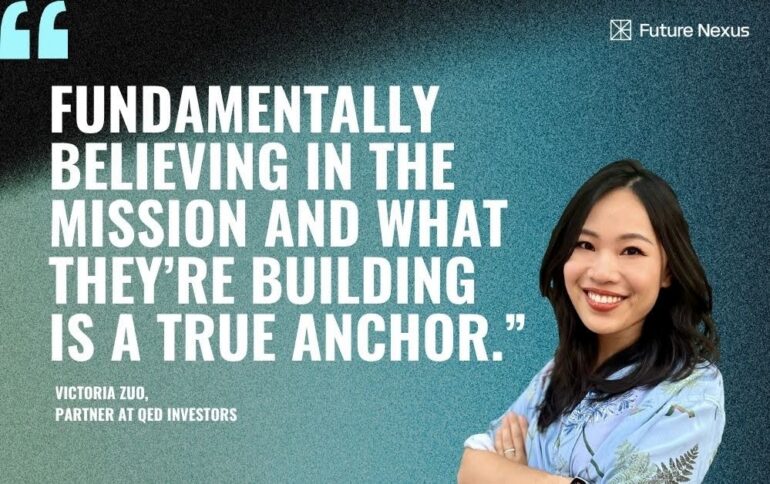
“There’s an incredible level of frothiness in the market and it’s easy to get very distracted by money, by fame, by fast exits and unsustainable growth, but fundamentally believing in the mission and what they’re building is a true anchor.”