

When the subject is machine autonomy, the first thing that most people picture is a Waymo threading through downtown San Francisco traffic. But if you put that same stack in a remote California almond orchard, it stops working almost immediately.
Dense tree canopies block the GPS signal, harvest throws dust thick enough to coat a camera lens within minutes, and the ground is rutted and strewn with branches and irrigation lines, shaking hard enough to work electronics loose. But the industry spent two decades automating just the easy version of the problem: big, expensive tractors with satellite guidance to work through open fields of corn, soy and wheat, where the equipment margins are fat, and the sky is clear.
Specialty crops (orchards, vineyards, berry fields), on the other hand, are worth far more per acre, but the machines that work them sell in the hundreds, not the tens of thousands – severely insufficient volume to justify the engineering. As a result, they were left alone.
Tyler Niday spent seven years inside the company solving the easy version. Now, he’s taking on the harder gap with Bonsai Robotics, a San Jose company that builds a camera-based autonomy stack for off-road machines, sold both as a retrofit kit for the equipment growers buy from OEMs and inside its own line of electric machines.
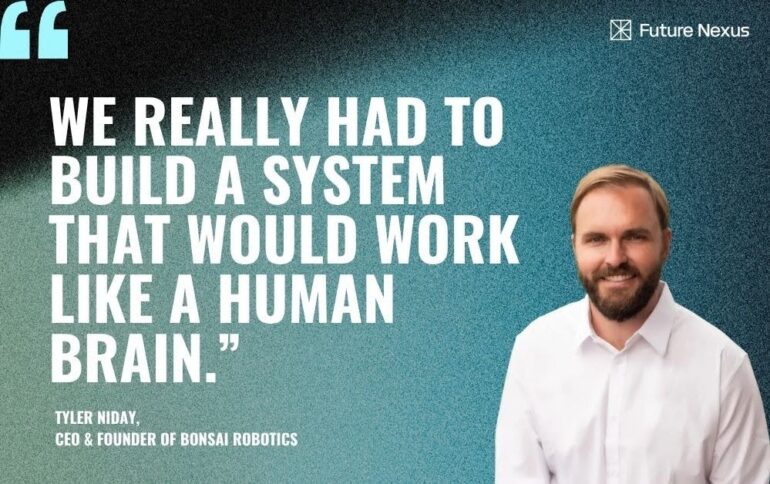
“I just saw a huge need for it in specialty crop operations,” Niday said in an interview with Future Nexus. “But specialty crops are challenging. There’s a lot of labor, but there’s a lot of different crops that all look different. You can’t be reliant on GPS to follow the navigation system. So we really had to build a system that would work like a human brain. It would work in dust. It would work in debris. It would work without GPS in these conditions.”
Beach to farm boy
While Niday’s day-to-day is all about specialty farm operations and how to make them better, he did not grow up around any of it. He grew up in a beach town.
“I wasn’t a farm boy. Maybe I’ve earned the right to be that now,” he said.
When he was twelve, he got a welder and became fascinated with building things, mostly out of metal. That started a journey that took him to Orchard Machinery Corporation (A company Bonsai now partners with). OMC builds the machines that bring in a tree nut harvest, including a shaker that clamps onto a trunk and spins two eccentric masses to generate 50 Gs of force, enough to knock the almonds loose.
Then came Blue River Technology, a company whose stated goal was to turn the Mississippi River blue again by cutting agricultural chemical runoff. On his first visit to the field – before deep learning, before GPUs – he found eighteen desktop computers bolted to the back of a tractor thinning lettuce, which was work that normally took thirty or forty people walking the rows with hoes.
“Watching this machine run was one of the most beautiful things I’d ever seen,” he said. “I’d never seen a machine that worked like that.”
Working there for seven years, he was part of the team that pivoted into deep learning and built See & Spray, the weed-targeting system that is now standard across row-crop farming. John Deere bought the company in 2017 for $305 million. After the acquisition, Niday helped start the autonomy team that still sits inside Deere.
From all these experiences, Niday saw the one thing being left out from the wave of autonomy – specialty crop operations, or tasks like spraying, weeding, mowing, and inspecting.
“Autonomy was going after open field operations and these big tractors that have an amazing hardware product line with a high gross margin,” he said. To fix this, in 2022, he teamed up with Blue River colleague Ugur Oezdemir and started Bonsai Robotics.
Cameras, and nothing else
When Niday and Oezdemir started Bonsai, there was no ChatGPT and not even the industry term “physical AI.” The bet was unfashionable but pretty clear to them: build a monocular vision stack cheap enough to put on a working machine to make it navigate and eventually handle farm ops without satellite guidance.
They did not build the app, or the global planning, or the implement controllers. They built vision-assisted steering and spent the early years bolting cameras onto partners’ machines and collecting real-world data for building the data flywheel for autonomous operations.
However, in the early days, shipping results in the field proved harder than building the system. Bonsai put the early versions of its stack into the Australian outback, where it runs 120 degrees with no cellular coverage and the nearest support is a long way off. Dust got past the model and onto the lenses, which turned out to be a hardware problem rather than a perception one. Plus, compute fried in the heat before they had the cooling right.
“We might have also knocked over a tree or two, which is not the prettiest thing,” the CEO said, while noting that this was the fundamental learning curve and that he “wouldn’t change any of this.”
“The quicker you get out to the field and run these machines from the customer’s standpoint is kind of everything. The first time you ask for money is really the first indication of product-market fit.”
Fast forward to today, Bonsai claims to have more than 400 machines deployed across the United States and Australia, and more than a million acres of collected data behind them. The first commercial autonomous deployments went out in early 2025, with Niday saying bookings and revenue are growing between 3.5-4x year over year.
The quiet pivot to win on economics
Bonsai started as a software company selling an autonomy kit that went onto someone else’s machine, either retrofitted in the field or installed at the factory, and it reached growers through OEMs like Orchard Machinery Corporation and Flory Industries rather than selling to them directly.
In July 2025, Niday and team expanded the business model by buying farm-ng, a Watsonville company building the Amiga, a modular electric platform focused on autonomous-first form factors. The reason was simple: autonomy-first machines could change the economics of operation, especially under certain conditions.
“If an autonomous tractor saves 18% per hour at a 1200-hour-per-year operational life cycle, the autonomy-first machines can save up to 60%,” Niday said, adding that the capital cost of an autonomy-first machine is about half that of the tractor it replaces, because the customers are not paying for a cab, a transmission, or a large hydraulic system.
He also pointed out that the running costs fall with autonomy-first machines. Where a conventional strawberry sprayer burns about 35 gallons of diesel a day, Niday claimed the Amiga burns only three.
With California diesel at a record high — roughly $8.38 a gallon in early October, nearly double where it sat in January — those gains are massive.
Building for edge cases
With a strong data, software, and hardware stack built over the years, Bonsai solved specialty crop ops based on what its machines have seen. But it did not cover what the systems haven’t seen or things nobody expects to show up.
Niday pointed to one case. Last year, a Bonsai mower kept stopping. It was working properly, but cutting a field turned up worms and insects, which birds noticed — and started circling the site, dropping in and out of the frame. The autonomy system read every one as an obstacle in its path and stopped, started, and stopped again.
Nobody had trained it on this behavior from birds. There was no reason to. In three years of data collected via driving through orchards, vineyards, and strawberry beds, in no case did a flock behave like this.
“We had never seen that before,” Niday said.
The usual fix for the problem was to go back to the field, find more birds, collect more footage, and retrain the autonomy stack to adjust as they appear. Now, to save time and effort, Bonsai has built a world model that generates the birds – or any other object/environment, for that matter – on the fly instead.
Bonsai World, built on top of NVIDIA’s Cosmos model, starts with a satellite image of a farm or any other rugged environment and then transforms the 2D map into a 3D simulation, where machines can recreate real paths and interact in the environment, generating ground-level views with conditions such as dust, debris, animals, vehicles, and changing terrain. This essentially enables the company to not only evaluate the readiness of the autonomy stack for a given farm but also to train it and prepare it for deployment.
“We’ve used Cosmos, which is a great on-road world model,” Niday said. “But because we’ve had this really diverse data set, we’ve been able to post-train it and really speed the development cycle.”
He said the system has 10x’d their data flywheel and even opened new use cases, including training for kiwis, an over-the-road vine system Bonsai had never operated in. The company trained for it entirely on its world model data and arrived at outcomes good enough to run.
Hand problem remains
As Bonsai moves forward to solve most of the gaps in specialty crop operations in rugged and continuously changing conditions, Niday is clear about what still needs to be addressed – harvest.
“Manipulating and picking a strawberry, picking an orange – these types of really labor-intensive hand operations have not been solved yet in this space. And it’s a massive market,” he said.
Niday thinks the technology has arrived for it, and that what remains is hardware and data rather than a conceptual gap. However, he’s not racing to go into that category, at least not immediately.
“You have the best arm in the world that can pick everything. You still have to be able to navigate, tell it what to do, get it in and out of the field,” he said.
Essentially, build the platform first and hang an arm on it later.
Beyond agriculture, Niday said Bonsai has been pulled into mining, defense and construction, and now has customers in all three (without sharing the specifics of who or where). What transfers, he said, is the rugged navigation stack and point-to-point transport, with partners supplying the implements.
When asked about competitors, including Waymo veterans’ Bedrock Robotics (focused on autonomous excavation work), Niday didn’t seem worried. Instead, he said they are “definitely not overlapping,” but that might change one day. He emphasized that the $30 trillion market for outdoor physical AI has room for many winners operating in their own specialized domains.
Eventually, he hopes to see the system scale up so that ten years out, a small farmer could move away from dealing with chemicals in their day-to-day work, and maybe even go to their kids’ football game while the field gets worked.
“We can give every tree or plant the master bonsai treatment,” he said. “We’re not going to manage farms anymore; we’re going to manage plants.”
