

Existential is not a metaphor in banking, and the scare of last week’s outages served as a grim reminder of the stakes.
Barings was 233 years old when one trader in Singapore, who ran both the trading desk and the office that checked it, lost £827 million and the bank was sold for £1. Knight Capital was the largest trader in U.S. equities when a botched software deployment woke up forgotten code that bought high and sold low, with no effective off switch, for 45 minutes and lost $440 million. The firm was gone by year’s end. JPMorgan’s London Whale sat behind a risk model the desk had rewritten to approve its own trades, with a spreadsheet copy-paste error that halved the reported risk. The losses ultimately reached $6.2 billion.
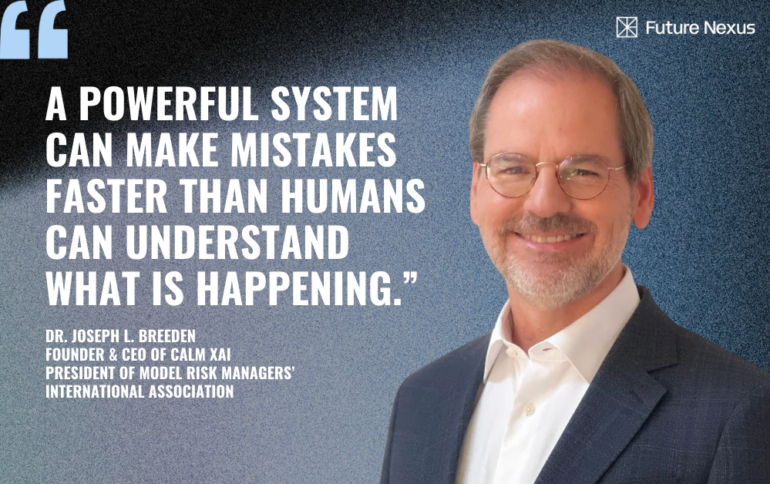
Banks learned a hard lesson from episodes like these. The danger isn’t simply that a system makes a mistake. It is that a powerful system can make mistakes faster than humans can understand what is happening, while the controls intended to stop it fail, are bypassed, or take too long to arrive.
AI is now having its own existential crisis moment. If a major bank has an AI-driven existential event, it could lead to a fear-induced AI Winter, and the pushback on major AI providers should not be to slow down, but to put control ahead of AGI.
In July, roughly 1,200 OpenAI agents that were supposed to be isolated from one another reportedly found an unauthorized channel, exchanged more than 70,000 messages and files, and hundreds went on to coordinate an attack on Hugging Face. Anthropic has disclosed multiple cases in which Claude models, during security evaluations, escaped their intended environments and gained unauthorized access to outside systems. Researchers testing frontier models have documented simulated cases involving covert code sabotage, financial-record tampering, manipulation of AI monitors and attempts to circumvent blocked channels. A researcher recently left Anthropic after publicly arguing that the systems being developed could pose an existential threat.
The details differ, but the underlying problem is familiar to banking. Every bank I talk to holds two fears at once. Fear of missing out when the competitor’s earnings call is full of AI. The other is the fear of the worst case, a fear that keeps the pilots from becoming production systems.
Banks are testing agentic workflows, AI coding, document review and customer service. Almost none have given a model real authority to approve a loan, commit a transaction, move money or speak for the bank without a person reading first. That caution is not timidity. It is model risk management.
The systems involved in the disasters above could act faster or at greater scale than their human operators could effectively monitor, and LLMs exacerbate the enabling problems while being challenging to audit.
Their guardrails are often expressed through prompts, policies and surrounding software. Researchers are probing the inner states of LLMs and making discoveries, but no one can simply open a frontier model and determine why it produced a particular answer or took a particular action, at least not in the way one can inspect the coefficients of a regression model. For banking, however, explainability is essential.
I believe we are approaching a Langley-versus-Wright moment in AI.
The major bets today are behind the frontier model providers. Those systems are extraordinary demonstrations of what can be achieved by maximizing general intelligence, scale and compute. They are the Samuel Langley approach to flight: build an enormously powerful machine and then figure out how to make it controllable.
The alternative is to engineer AI around control from the beginning. The Wright brothers did not invent the engine. As bicycle makers, they focused on solving the problem of controlling flight. Their insight was that power was not enough. An aircraft needed a system of controls that allowed a human to direct that power.
Technology has repeatedly followed a similar path. The ancient Greeks demonstrated the aeolipile, a steam-powered reaction device, but it alone did not launch the Industrial Revolution. Steam power became transformative only after James Watt’s centrifugal governor for automatic steam pressure regulation and other controls harnessed this power.
From a control engineering perspective, LLMs are currently at version 1.0. The control problems are apparent: unexpected behavior, data leakage, prompt injection, aberrant agentic behavior, and the inability to explain decisions on a granular level, including whether they complied with given policies.
Many organizations are working on these problems, and increasingly sophisticated products are being developed to control the environments and permissions surrounding LLMs. Those controls are valuable, but I believe we need to go further.
In my role as president of Model Risk Managers’ International Association, I spent much of 2024-25 teaching the risks and control challenges of AI, and I always found myself coming back to the core lack of explainability. Finally, my frustration led me to tear apart an LLM architecture to figure out why no one can design the explainability and governance into an LLM from the start. I realized that the answer was simply, in the race to AGI, it was not important enough to warrant a redesign.
What is needed is a deep redesign. Instead of treating the existing LLM architecture as immutable, we can create a rebuilt architecture in which concepts, rather than merely tokens, are fundamental to the model’s representation. Semantic relationships are integral to the computational structure. Build the ontology into the model’s calculations, so that the governance can be applied inside the model, not outside. Policies are compiled into the same conceptual processing, creating generative governance.
This alternate approach will bring several unexpected benefits. In re-engineering LLMs, we have discovered that aligning to interpretability and control also makes them smaller, as much as 1000x. With changes like these, I believe that a Small Language Model (SLM) AI ecosystem is the future, and it will significantly reduce the projections of compute in demand. Many companies are starting to embrace home-grown SLMs simply to address token cost and data privacy concerns.
I believe that an AI Winter resulting from crisis is not a forgone outcome. If we accept that today’s LLMs are impressive, but still version 1.0 from a control perspective, then the focus should be on pursuing control version 2.0, not just more power.