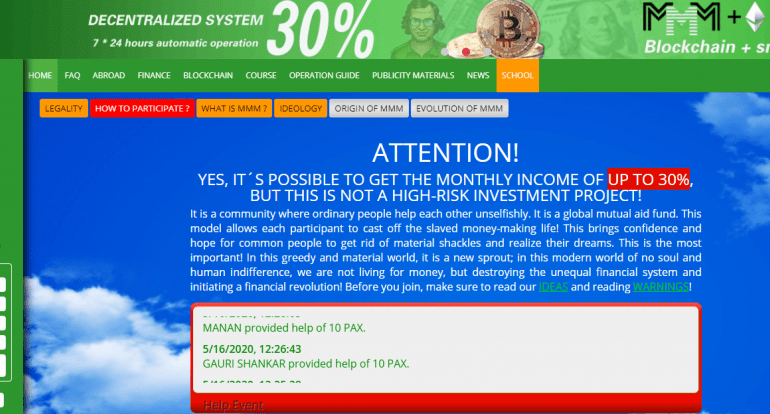
Let me introduce you to MMM. While decentralized finance and digital asset companies bend over backwards to be customer centric and reform financial services (each in their own way), MMM is a pretender. It is a pretender that has stolen the language of the crypto economy to create a cancer in its body.
central bank / CBDCChinacovid pandemicmacroeconomicsregulation & compliancesmall businessstablecoins
·This week, we look at cash -- blockchain cash. The war for money is just starting to ramp up, as Facebook Libra explains its new regulated plan, the Chinese national Blockchain Service network goes live, Ethereum stablecoins reach historic market caps in the billions, and the Financial Stability Board recommends to go heavy on global stablecoin arrangements. In 2008, Bitcoin threw a rock through the window of the financial skyscraper, and today we are starting to see the cracks. As the US government runs out of $350 billion in small business bail-out money and gets ready to print more, where do you stand?

The Securities and Exchange Comission punted again on allowing a passive Bitcoin ETF to enter the market. It failed to approve the VanEck SolidX Bitcoin Trust, instead opting to open a commentary period to address several questions around Bitcoin price formation and the health of the exchanges. A similar outcome faces the Bitwise Bitcoin ETF. You can tell I am not a fan of this waffling, and there are two core reasons: (1) the years-long delay and uncertainty is responsible for financial damage to both traditional and crypto investors, and (2) the premise of the objections misunderstand the environment of the Internet and the way our world is shaping up in the 21st century.
A new LexisNexis Risk Solutions report shows how an explosion in sanctions over the past few years has made compliance increasingly challenging for financial institutions.
artificial intelligenceaugmented realityCryptodecentralized financeenterprise blockchainMetaverse / xRnarrative zeitgeistNFTs and digital objectsregulation & complianceventure capital
·In this conversation, we talk with Jamie Burke of Outlier Ventures. This is a fascinating and educational conversation that covers frontier technology companies and protocols in blockchain, IoT, and artificial intelligence, and the convergence of these themes in the future. Jamie walks us through the core investment thesis, as well as the commercial model behind shifting from incubation to acceleration of 30+ companies. We pick up on wisdom about marketing timing and fund structure along the way.
·
Companies like Hummingbird and Babel Street are successfully applying new technologies to improve the efficiency of long-cumbersome aspects of compliance.
State regulators are stepping into action to regulate earned wage access. But the process is slow and could create a mismatch for providers.
·
This week, we look at:
How banks and financial advisors have failed to deliver on $1 trillion in capital appreciation for their clients over the last 12 years
The role of bank regulators in the United States, and the tensions between state and federal agencies
How the OCC is laying the groundwork for national banks to custody crypto assets, bank stablecoin reserves, run blockchain nodes, and use crypto payment networks
And instead of financial advisors or other CFAs guiding the retail market in good decision making, a newsfeed of *what’s popular* has driven Apple, Google, Tesla and the other John Galt hallucinations to the stratosphere. Don’t get us wrong. We love the robot as much as the next Fintech commentator. But it is clear to us that “the masses” are not being “advised”. And that the capital appreciation that matters — cementing the next trillion dollar networks for global future generations in work yet to emerge — is misunderstood and misrepresented by most financial professionals to their clients.
Money Laundering is a perpetual thorn in the side of financial institutions. BIS reports that AI and use of networks could be way forward.
In a case that has taken three years to reach a verdict, XRP token is found not to be a security. But Ripple isn't completely off the hook.