In this conversation, we talk with Tyler Mulvihill of Treum and EulerBeats, about how he became involved in the very first non-financial production grade blockchain use case, tracking & tracing tuna from Fiji to New York using Treum. Additionally, we explore the nuances of NFTs and how EulerBeats is using bonding curve economics to price the future of NFT use rather than mere collection.
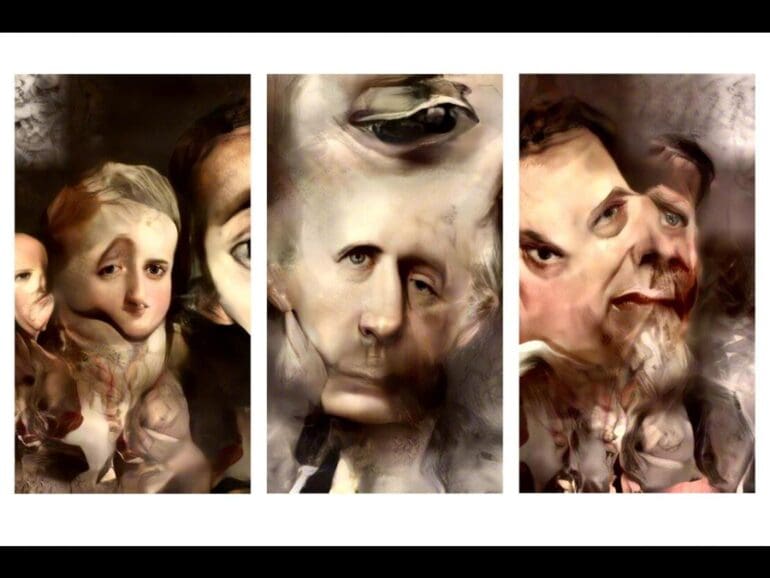
What we know intuitively, and what the software shows, is that the pixelated image can be expanded into a cone of multiple probable outcomes. The same pixelated face can yield millions of various, uncanny permutations. These mathematical permutations of our human flesh exit in an area which is called “latent space”. The way to pick one out of the many is called “gradient descent”.
Imagine you are standing in an open field, and see many beautiful hills nearby. Or alternately, imagine you are standing on a hill, looking across the rolling valleys. You decide to pick one of these valleys, based on how popular or how close it is. This is gradient descent, and the valley is the generated face. Which way would you go?
The evolution towards a financial metaverse is rapidly accelerating, with the growth in generative assets, profile picture avatars, the emerging derivative structures that build on their foundation, and DAOs that govern them. This article highlights the most novel developments, and builds the case for what a digital wallet / bank will need to be able to do in order to succeed on the way to this alien destination.
The image is taken from an AI paper which explains how to use generative adversarial networks (i.e., GANs) to hallucinate hyper realistic-imagery. By training on hundreds of thousands of samples, the model is able to create candidates representing things like “just a normal dude holding a normal fish nothing to see here”, and then edit out the ones that are too egregious.
The reason the stuff above is so scary is actually that you can mathematically transition in the space between images. So for example, you could move between “a normal dude” and “just a normal fish” and have nightmare fish people. Or you could create a DNA root for an image which is part dog, part car, and part jellyfish. Check out the video below and the very accessible https://www.artbreeder.com/ website to see what I mean.
We’ve had this write-up in some various mental states floating around for a while, and better done than perfect. So treat this as a core idea to be fleshed out later.
Payments and banking companies should be looking at how people purchase and store digital goods and digital currency in video games. That experience has been polished over 40 years, and is what will be the default expectation for future generations.
For those interested, here is a website that collects user experiences of shopping across hundreds of designs.
OpenAI, backed with $1B+ by Elon Musk & MSFT, can now program SQL and write Harry Potter fan-fiction
This week, we look at a breakthrough artificial intelligence release from OpenAI, called GPT-3. It is powered by a machine learning algorithm called a Transformer Model, and has been trained on 8 years of web-crawled text data across 175 billion parameters. GPT-3 likes to do arithmetic, solve SAT analogy questions, write Harry Potter fan fiction, and code CSS and SQL queries. We anchor the analysis of these development in the changing $8 trillion landscape of our public companies, and the tech cold war with China.
In this conversation, we talk with Beatriz Helena Ramos – artist, entrepreneur, film director, producer and illustrator – the mind behind DADA.art. DADA is “a space where everything is about cooperation and solidarity, which are amazing ways to allow self-expression, as well as constant inspiration. Additionally, we provide simple tools to encourage creativity, and erase intimidation.”
More specifically, we discuss Beatriz’s journey to creating DADA, decentralized power structures, community-inspired creative collaboration, assymetric rewards in NFT markets driving new value distribution methodologies, DADA’s latest project called “The Invisible Economy”, and technology-inspired and centric approaches to empower artists in the future.
In this conversation, we chat with Erick Calderon is the founder and CEO at Art Blocks, a platform for creating on-demand, generative art pieces. Since its launch a year ago, Art Blocks has garnered the attention of many, including auction house Sotheby’s, which recently sold 19 of the platform’s pieces in a deal totaling $81,000. Calderon, a native Houstonian, uses the online handle Snowfro, which stems from a snow cone stand he used to own.
More specifically, we touch on projection mapping, generative vs. algorithmic art, machine learning, smart contracts, the constructivist art movement, Artblocks’ unique approach to NFT algorithms and minting, NFT flipping vs. scalping, gas price wars, flashbots, dutch auctions, and the massive demand for anything Artblocks in the world today and the justifcations behind such demand.

Facebook is building towards a Metaverse version of the Internet, in both its hardware and software efforts. What are the implications? And further, how does one acquire status, work, and social capital in such a world? We explore the recent NFT avatar projects through the lens of Ivy League universities and CFA exams to understand some timeless cultural trends.
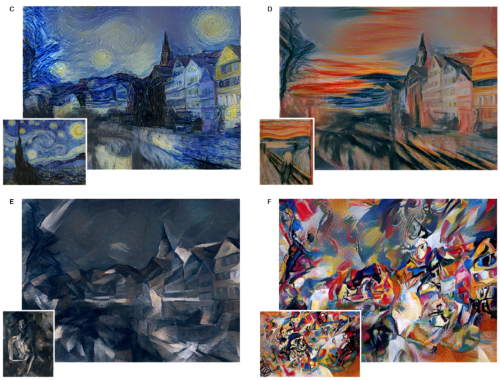
However, mastery is not immune to automation. As a profession, portraiture melted away with the invention of the Camera, which in turn became commoditized and eventually digitized. The value-add from painting had to shift to things the camera did *not* do. As a result, many artists shifted from chasing realism to capturing emotion (e.g., Impressionism), or to the fantastical (e.g., Surrealism), or to non-representative abstraction (e.g., Expressionism) of the 20th century. The use of the replacement technology, the camera, also became artistic -- take for example the emotional range of Fashion or Celebrity photography (e.g., Madonna as the Mona Lisa). The skill of manipulating the camera into making art, rather than mere illustration, became a rare craft as well -- see the great work of Annie Leibovitz.